Dutch Roundabout Rules Explained (Right of Way, Cyclists, Signalling)
Learn who has priority at Dutch roundabouts, how to handle cyclists, when to signal and how to choose a lane on multi-lane and turbo roundabouts.
Published Updated
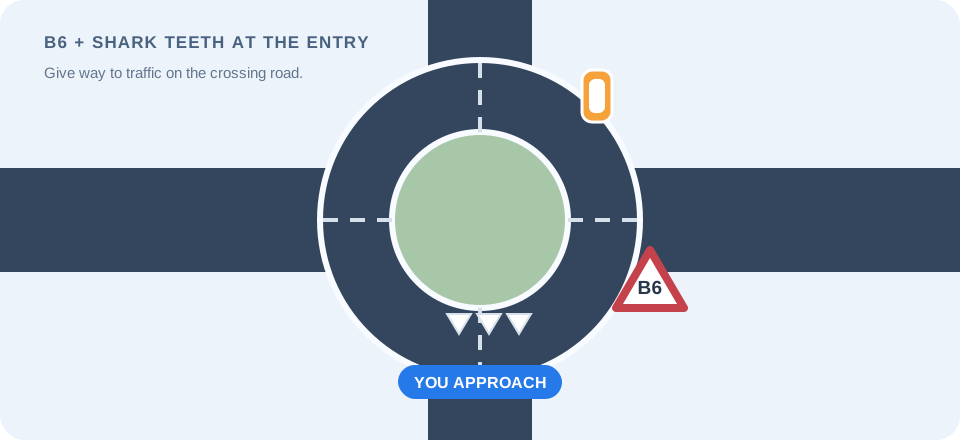
In the Netherlands, a roundabout does not automatically give priority to traffic already circulating. Follow the traffic lights, signs and road markings; if none set a different priority, traffic from the right has priority. A B6 sign or shark teeth at your entry mean you must give way to the traffic they govern.
Who has priority at a Dutch roundabout?
Look at the specific entry and exit before deciding who goes first. The shape of a roundabout does not create a separate, universal priority rule.
- B6 sign or shark teeth: give way to traffic on the crossing road. At many roundabouts, that means waiting for traffic already circulating to pass. RVV 1990 Article 80 defines shark teeth as a requirement to give way to drivers on the crossing road.
- No priority signs, signals or markings: the ordinary right-hand rule applies. A driver approaching from your right may have priority—even if that driver is entering the roundabout while you are already circulating. This follows from Article 15 of the RVV.
- Signals or a traffic controller: follow those instructions. Do not assume that a familiar-looking roundabout has the same priority layout as another one.
For a quick refresher on the default rule and signs, see our guide to Dutch priority rules.
Cyclists: check which path and which crossing
Roundabouts can have a cycle lane on the carriageway, a separate cycle track around the outside, or both. They are not interchangeable:
- Cycle lane on the carriageway: cyclists are using the road with you. Check beside you before moving across the lane or turning.
- Separate cycle track: check the signs, traffic lights and markings at each entry and exit. A red surface by itself does not tell you who has priority. If shark teeth face your lane at a crossing, give way to traffic on that crossing road.
- Two-way cycle track: look both ways before crossing it; a cyclist may approach from the direction you do not expect.
The ANWB notes that a nearby cycle track can form part of a roundabout; its guidance describes a track less than eight metres away as part of the roundabout. That is useful context, not a substitute for checking the actual layout and priority signs at the crossing. When you turn across cyclists travelling on the same roadway, Article 18 of the RVV requires you to give way to traffic continuing straight. For a separate cycle track, check its own signs and markings.
The safest exam habit is to identify the kind of cycle facility first, then read its signs and road markings. Our guide to driving around cyclists in the Netherlands explains cycle lanes, cycle paths and turning across cyclists in more detail.
When to signal
Signal right in good time before leaving the roundabout. Article 55 of the RVV requires a signal when leaving a through carriageway; the ANWB also advises signalling right before taking an exit. Use an indicator before a lane change as well. It tells others what you intend to do—it does not give you priority.
When approaching, follow the signs and lane arrows for the exit you want. Do not use an entry signal as a substitute for checking priority or the path of cyclists.
Multi-lane and turbo roundabouts
There is no single lane rule that fits every multi-lane roundabout. Read the destination signs and arrows before entering, choose a lane that follows the route for your exit, and stay within its markings. Check mirrors and blind spots before any permitted lane change.
Turbo roundabouts use lane markings and sometimes raised separators to guide drivers to particular exits. Choose your lane before entering. If you realise too late that you are in the wrong lane, do not cut across a separator or force your way across another lane; follow the indicated route and find a safe way back.
Large vehicles may need extra room, so do not linger beside them or assume they can stay within the same turning path as a car.
Common roundabout mistakes
- Assuming traffic on the circle always has priority.
- Treating every cycle track as if it has the same priority.
- Looking only at signs and missing shark teeth on the road.
- Choosing a lane late or changing lanes without checking.
- Signalling but failing to give way when the signs or markings require it.
- Stopping on the roundabout when no traffic or signal requires a stop.
Try five roundabout questions for free
Test the rules with five short questions on priority, cyclists, signalling and lane choice. The practice round is available without signing in and explains each answer.
Start the five-question roundabout practice
These are original study questions, not official CBR exam questions. For a full exam-length run, try the free CBR-style practice exam.
Sources
- RVV 1990, Article 15: priority from the right
- RVV 1990, Article 18: turning traffic
- RVV 1990, Article 55: signalling
- RVV 1990, Article 80: shark teeth
- ANWB: roundabouts and cyclists
- CBR: Rijprocedure B (July 2026 edition)
Frequently asked questions
Who has priority at a Dutch roundabout?
A roundabout does not automatically give priority to traffic already circulating. Follow the signs, signals and road markings; if none set a different priority, the usual rule gives priority to traffic from the right.
Do cyclists always have priority at Dutch roundabouts?
No single rule covers every cycle track. Check the signs, traffic lights and shark teeth at each entry or exit; if shark teeth face your lane, give way to traffic on the crossing road.
When should I signal on a Dutch roundabout?
Signal right in good time before leaving the roundabout. Signal before changing lanes too; an indicator does not give you priority.
How do I choose a lane on a turbo roundabout?
Read the route signs and arrows before entering, choose the lane for your exit and follow its markings. Do not force a lane change across a separator.